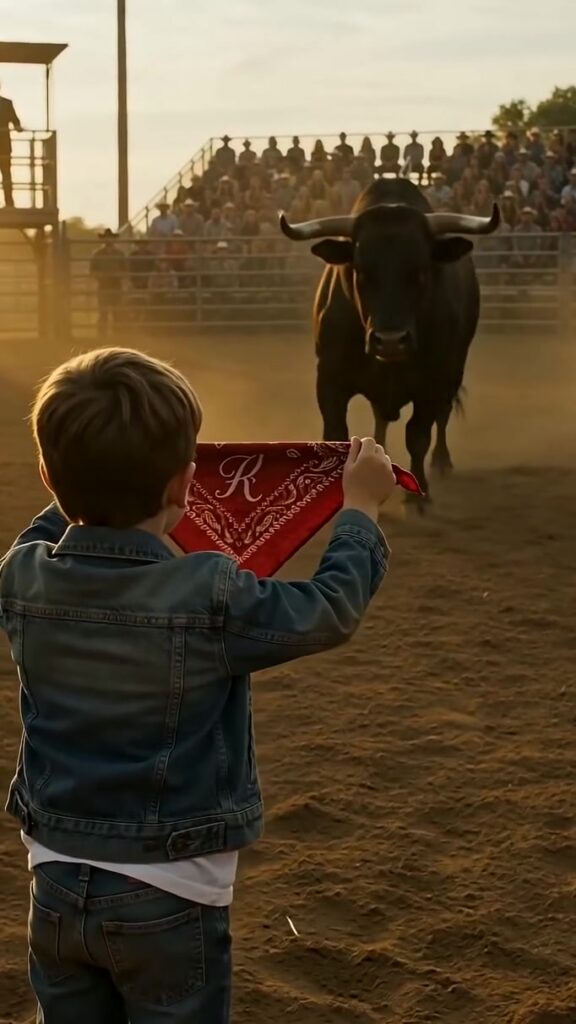
The rodeo was pure chaos—dust flying, crowds roaring, sunlight burning through the arena like fire. The metal bleachers trembled under stomping boots and pounding fists while vendors shouted over the music and the loudspeakers crackled with static. At the far end of the ring, a giant black bull named Ranger pawed the dirt near the gate, shoulders heaving, hide slick as spilled oil. Every breath he exhaled looked like steam in the heat.
Ranger had a reputation that traveled faster than the carnival lights that followed the circuit. Some called him a monster. Others called him a legend. The riders called him a sentence. Even the clowns—those brave, painted men who laughed in the face of horns—kept one eye on Ranger and the other on the nearest fence.
Tonight was supposed to be a clean show. A local sponsor had paid for extra security, the gates were checked twice, and an announcer with a voice like thunder promised “the wildest eight seconds of your life.” Then the latch on a side rail gave a small metallic cough. No one noticed at first, not in all that noise, not with the spotlight sweeping the ring like a searching finger.
A small body rose in the air as if tossed by the crowd itself. A child cleared the railing, arms flailing, and dropped into the arena with a sound that cut through the music—a hollow thud followed by a sharp inhale from thousands of mouths. For a heartbeat the whole place froze, as if even the dust stopped moving.
The camera that fed the jumbo screen swung hard. The audience saw what the people closest to the rail already knew: an eight-year-old boy in a denim jacket too big for his shoulders, knees scraped raw, trying to sit up like he’d merely tripped on a sidewalk. A cowboy hat lay upside down a few feet away, its chin string snapped.
“Kid!” the announcer’s shout exploded from the speakers, rougher than the music, urgent enough to bruise. “Move! Get to the fence!” His voice echoed off the grandstands, multiplying into panic.
The boy didn’t run. He pushed up on his palms, shaking, and stared across the ring at the black bull that had slowly turned to face him. Ranger’s head lowered, nostrils flaring. The bull’s muscles rolled under his hide as he shifted weight from hoof to hoof, measuring distance the way a storm measures an open field.
Then the boy did something no one expected. He opened his fist.
From his small, dirt-streaked hand dangled a faded red bandana. It looked old—washed thin, edges fraying, the color dulled to the shade of dried blood. The boy lifted it with both hands as if it were a flag he didn’t know how to carry.
“Please,” he said, and his voice somehow reached the front row, then the second, then traveled like a whisper carried by wind. “Look at me.”
Ranger scraped his hoof. Dirt and dust leapt into the air. Someone screamed. Someone else prayed. Two men at the gate worked the latch like it was welded shut, fingers slipping with sweat.
The boy held the bandana higher. In one corner, stitched in uneven thread, were two initials: J.H.
“My dad said you’d know,” the boy called, tears clinging to his lashes. “He said you’d remember.”
The crowd’s noise didn’t vanish all at once. It fell in sections, like lights turning off down a hallway. First the left bleachers quieted. Then the center. Then even the drunkest men near the beer stand stopped laughing. The only sounds left were the creak of the fence, the distant hum of the generator, and Ranger’s breath.
The bull stopped staring at the boy’s face. His gaze fixed on the cloth.
Ranger took a step forward. Slow. Heavy. Each hoof landed like a hammer in dirt. Another step. Another. The space between them shrank. People stood up, hands over mouths, as if they could catch the boy with their fingers.
“Come on!” someone yelled. “Run!”
The boy stepped forward instead. His boots sank slightly in the loose soil. He looked impossibly small under the open sky, like a candle refusing the wind. “If you remember him,” he said, voice breaking, “then you won’t—”
Ranger charged.
It happened so fast the camera blurred. The bull’s head dropped; his shoulders surged; the dust burst outward behind him like a wake. The announcer’s voice cut out into a strangled sound, and for one terrible moment, the whole arena became a single held breath.
The boy squeezed his eyes shut, then forced them open, and lifted the bandana higher as if lifting it could lift him out of danger.
Ranger stopped inches from him.
Silence slammed down so hard it felt physical. The bull’s breath washed over the child, hot and sharp, and the boy’s jacket fluttered as if struck by wind. Ranger’s nostrils flared once, twice. Then, slowly—so slowly the motion looked like a decision—he lowered his massive head and pressed it gently against the boy’s chest.
A sound rose from the crowd—not a cheer, not a scream, but something between disbelief and awe. The boy’s arms wrapped around the bull’s thick neck without thinking, fingers curling into coarse hair. He began to sob, shoulders shaking.
At the edge of the ring, just beyond the chute, an old ranch hand in a sun-faded hat went still. His name was Earl Madsen, and he’d worked these grounds since before the arena had real lights. His hands were stained with decades of rope and oil. When he saw the initials on that bandana, the color drained from his face as if someone had pulled a plug.
The boy lifted his head, still clinging to Ranger with one arm. He looked across the ring at Earl, eyes red and fierce. For a moment he didn’t seem eight years old at all.
“You lied,” the boy shouted, the words cracking like a whip. “You lied to my dad before he died!”
Every head turned toward the old ranch hand. The camera found him and threw his shocked face onto the big screen, magnifying the tremor in his jaw. Earl’s mouth opened, but nothing came out. He glanced at the bandana again as if it were a ghost he couldn’t deny.
The boy swallowed hard and raised the cloth for everyone to see. “This was his,” he said. “You told him Ranger wasn’t his anymore. You told him the bull forgot him.” He pressed his palm to Ranger’s forehead as if proving a point. “But he didn’t.”
Earl’s shoulders sagged. The crowd, still stunned, began to murmur—questions, accusations, old stories stitched together in real time. Somewhere in those murmurs, a name surfaced: Jonah Hart. A rider who’d vanished from the circuit after a wreck. A rider who, rumor said, had been cheated out of his prize money and his animals by the people he trusted.
Ranger lifted his head and swung it toward Earl, horns catching the sunlight. The bull didn’t move to attack. He simply looked. It was worse than a charge; it was judgment.
Earl took a step back, boots dragging a half-moon in the dirt. He raised his hands as if facing a gun. “I didn’t mean for it to happen,” he rasped, voice barely audible without the microphone. “I was trying to keep the sponsors. I was trying to keep the show alive.”
The boy’s voice cut through him. “My dad kept it alive,” he said. “And you let him die thinking he was nothing.”
Ranger snorted, a low thunder that rippled through his chest. The gates finally clanked open behind him, men ready with ropes and flags, but no one dared rush in. Not while the bull stood like a monument with a child at his side.
In the hush that followed, the boy’s small hand tightened around the bandana, and the red cloth fluttered once in the hot wind—less like a relic now, more like a warning. The rodeo lights blazed on, indifferent, but the arena had changed. The story people came to watch had been replaced by one they couldn’t unsee.
And in the center of it, Ranger stood calm at last, as if he’d been waiting for the right person to return something that was stolen—something stitched in thread, carried in memory, and finally spoken aloud.