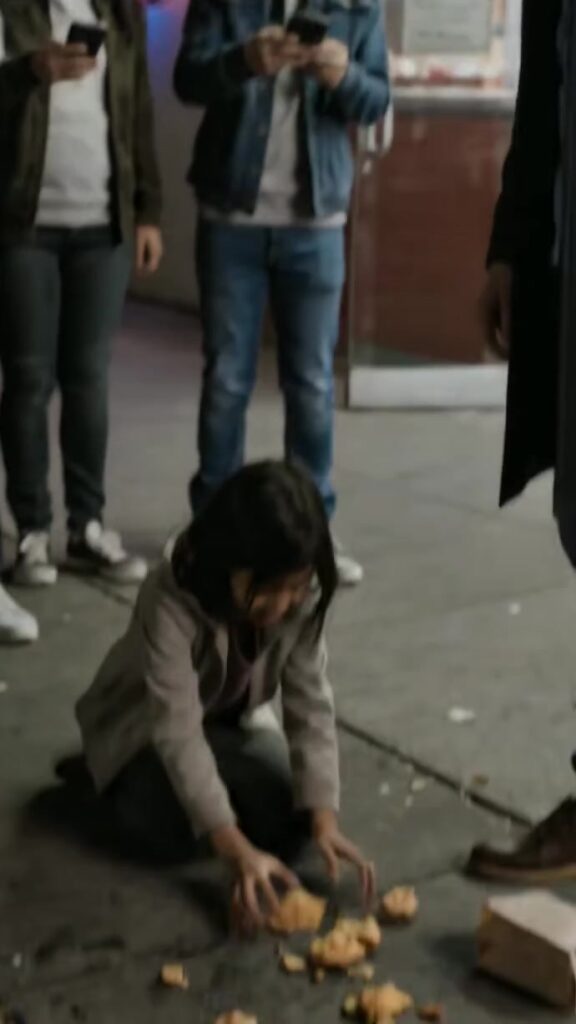
Rain stitched silver threads across the neon-lit pavement, turning every puddle into a trembling mirror. The fast-food sign—red, electric, impossibly cheerful—bled color onto the sidewalk where people drifted in clusters, collars up, screens glowing in their palms. Cars hissed by, laughter ricocheted off storefront glass, and the night moved with the careless rhythm of a city that believed it was safe.
Near the entrance, a little girl stood so still she looked like someone had forgotten to animate her. Damp hair clung to her temples. Her jacket hung a size too large, sleeves swallowing her wrists, and both hands clutched a small paper bag as though it contained something fragile, something alive. She wasn’t calling out. She wasn’t performing hunger for spare coins. She simply watched the door, blinking hard against the rain, as if waiting for a signal only she could hear.
The door swung open, spilling warm light and the scent of salt and grease onto the sidewalk. A young man strode out with the easy swagger of someone for whom the world made room. His friends followed in a loud knot—expensive coats, bright teeth, jokes thrown like confetti. His hair was carefully undone, his watch a polished flash at his wrist. He glanced at the girl, and something in his face sharpened into amusement that wasn’t kind.
He veered toward her, rain sliding off his shoulders like he belonged above the weather. “What’s that?” he asked, loud enough for his friends to hear. Before she could pull the bag closer, his hand closed around it and tugged. The girl’s fingers held on for half a second—then slipped, as if her strength had an expiration date. He opened the bag with exaggerated curiosity, and when he saw the food inside—wrapped, still warm—his mouth curled. With a casual flip of his wrist, he emptied it onto the sidewalk. Fries scattered into a shallow puddle. A sandwich slid, unwrapped, into rainwater and grit.
His laughter was the first sound. Then his friends. Then silence, as though the street had inhaled and forgotten how to exhale. A few people stopped walking. Someone muttered a curse. Screens rose, not in sympathy but in reflex—rectangles of light capturing the moment like it was a show that belonged to everyone now.
The girl dropped to her knees without hesitating, palms pressing into wet concrete. She reached for the food with frantic precision, trying to pluck it from the puddles as if she could separate what was ruined from what was still usable. “No, no… please,” she whispered, each word breaking on the rain. Her hands shook. She didn’t look up at the young man. She didn’t look at the cameras. She looked only at the food, as if it were the last thread keeping someone else tethered to life.
As she fumbled with the soggy paper bag, something small tumbled out and rolled, clicking softly against the pavement. Then another. They spun in the reflected neon before coming to rest at the young man’s polished shoes: a child-sized inhaler and a tiny medicine bottle with a pharmacy label smeared by rain. His smile faltered, then vanished completely, as if the night had reached up and wiped it away.
The girl’s voice went thinner, rawer. “My brother,” she said, not to him but to the air, as though confessing to the storm. “He… he can’t swallow them without food. If he takes it on an empty stomach he throws up. And then—” She swallowed hard, eyes fixed on the pills as if they might flee. “And then he can’t breathe. He’s waiting. In the alley. He gets scared when it’s loud.”
A sound rose from the crowd—an unsettled murmur, like a wave finding rocks. Someone lowered their phone. Someone else kept filming but their hand trembled. The young man’s friends shifted, their laughter evaporating into embarrassment. The young man himself stared down at the inhaler as if it were an accusation with a mouth.
Then the restaurant door burst open again. An older woman hurried out, apron tied tight, hair pinned back with the exhaustion of a double shift. She looked ready to scold whoever was blocking the entrance—until her gaze landed on the girl on the ground. The woman stopped so abruptly her shoes skidded on the wet tile. Her face drained of color, eyes widening, hand rising to her mouth as if to keep something from spilling out of it.
She took one step forward. Then another, slow and disbelieving, as though the girl might dissolve if approached too quickly. “That child…” she breathed, voice almost swallowed by the rain. Her eyes searched the girl’s face with an intensity that did not belong to a stranger. “Those eyes. I… I know those eyes.” Her lips trembled. “Like my daughter’s.”
The young man turned at the change in her tone, irritation ready on his tongue—and then he went still, because he recognized the woman too. Not from warmth. From history he’d been told was irrelevant. From a photograph once seen in a drawer he wasn’t supposed to open: a younger version of her, smiling, beside a headline his father had called “ancient lies.”
A man in the crowd, older, a local blogger who filmed everything, lowered his phone just long enough to squint at the woman’s face. “Wait,” he said, voice rising. “That’s Teresa Rowan.” The name hit the sidewalk like a dropped plate. People repeated it, confused at first, then sharper. Teresa Rowan—the woman who had vanished from the city’s society pages a decade ago, the former aide who’d accused the Kline family of burying a scandal and then disappeared into nowhere jobs and quiet streets.
The young man—Dorian Kline—felt his stomach tighten as if a fist had closed inside it. The cameras, which had been aimed at his cruelty, adjusted like hungry eyes. Someone recognized him too. “That’s Kline’s son,” a voice said. “Councilman Kline’s kid.” The street didn’t feel alive anymore. It felt awake.
Teresa ignored the murmuring and knelt beside the girl, careful, gentle. “Sweetheart,” she said, voice cracking, “what’s your name?”
The girl hesitated, as if names could be stolen too. “Anya,” she whispered. “My brother’s name is Misha. He’s… he’s back there.” She jerked her chin toward the alley, rainwater streaking down her cheeks like more than weather.
Teresa’s hands shook as she looked at the inhaler and the medicine bottle, then at the food on the ground. Something old and furious moved behind her eyes. “Help her,” she snapped, not begging. Commanding. A bystander—then another—stepped forward. Someone pulled off their jacket and held it over the girl like a roof. Another person scooped the ruined food away and ran back into the restaurant to buy replacements without waiting to be asked.
Dorian stood there as the world rearranged itself around the child he had tried to humiliate. The puddles reflected his face in broken pieces. His friends were suddenly strangers, hovering at the edge of consequence. He watched Teresa cradle the inhaler as though it mattered more than pride, more than any performance. In her expression he saw a grief that had been waiting years for a doorway to open.
“You,” Teresa said, finally lifting her gaze to him. There was no fear in it. Only recognition and something like judgment sharpened by survival. “You don’t know what you’re stepping on,” she said softly, and the softness was worse than shouting. “You never did.”
For a moment Dorian wanted to speak—an apology, an excuse, a joke to slide out of responsibility. But the cameras were steady. The rain was relentless. And a little girl’s shaking hands had made the truth visible: power was not a coat, not a watch, not a name. Power was deciding whether someone else got to breathe tonight.
He bent down, slowly, and picked up the inhaler and the medicine bottle, holding them as if they might shatter. His voice came out rough. “Where is he?” he asked.
Anya pointed. Teresa rose with him, and the crowd parted without being told. The neon sign buzzed overhead, still cheerful, still selling comfort. But the street had changed. Somewhere in the alley, a boy waited for his sister to return with enough food to make medicine go down. And behind them, the city kept filming—this time not for entertainment, but because sometimes the only way to stop a lie from surviving is to force it into the light.