How to Grow Mushrooms at Home from Store‑Bought Mushrooms
Growing mushrooms at home using mushrooms from the supermarket is surprisingly simple, eco-friendly, and satisfying. Below is a clear, step-by-step method to help you turn store-bought mushrooms into a continuous supply.
Materials You’ll Need
- Fresh store-bought oyster mushrooms (or other suitable varieties)
- A sterile glass jar with a lid (for starting mycelium)
- Grains such as corn or wheat berries (to expand the mycelium)
- Straw or sawdust (the main growing substrate)
- A clean plastic bottle or plastic bag (for the fruiting stage)
- Clean water and a spray/misting bottle
- Cotton or a breathable filter for the jar lid (to allow airflow and reduce contamination)
- Rubber bands or string (to secure bags or bottles)
Step 1: Make a Mycelium Starter (Grain Spawn)
-
Prepare the mushroom pieces
- Take several store-bought oyster mushrooms.
- Trim off the stems and cut them into small chunks.
-
Sterilize and fill your jar
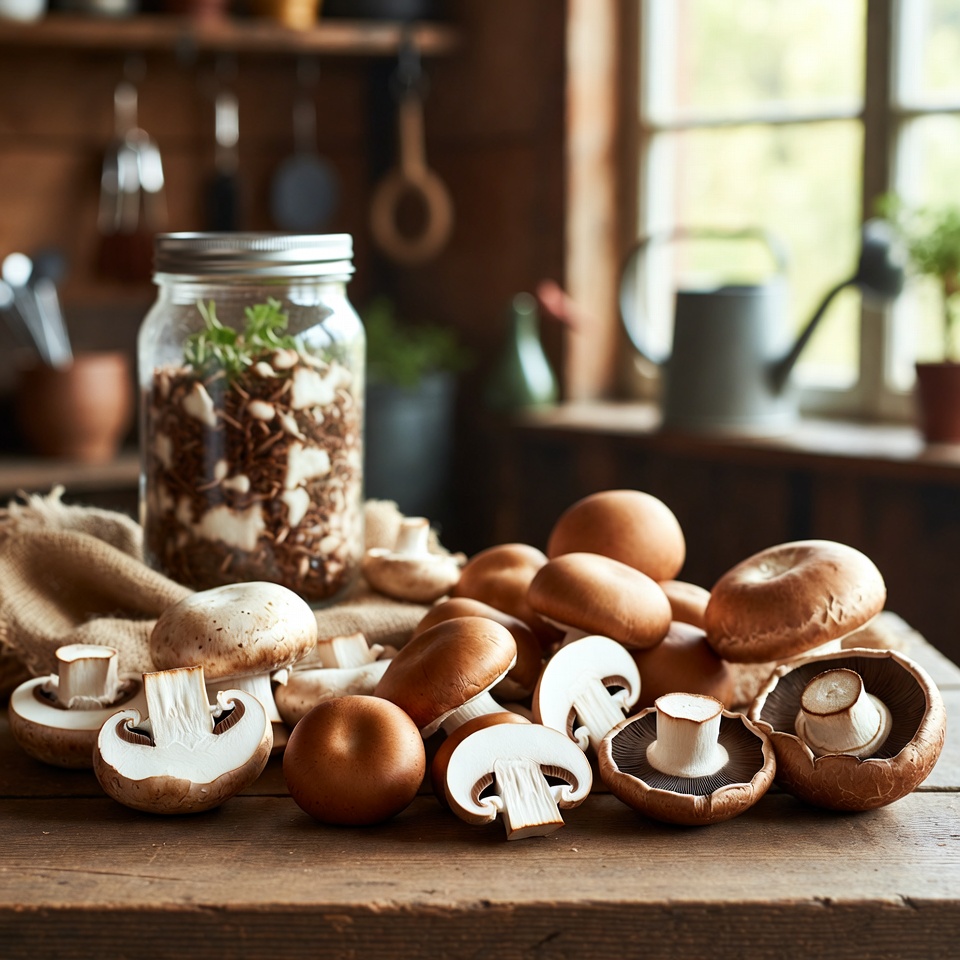
- Boil your grains (corn, wheat berries, etc.) until cooked but not mushy.
- Drain well and allow them to cool.
- Place the cooled, sterilized grains into your clean jar.
-
Inoculate the grains
- Push the small mushroom stem pieces into the grains inside the jar, spreading them out as evenly as possible.
-
Allow air exchange safely
- Fit the lid onto the jar, making sure it has a small hole plugged with cotton or fitted with a breathable filter.
- This lets in fresh air while keeping out contaminants.
-
Incubate the jar
- Store the jar in a dark place at around 20–25°C (68–77°F).
- Over 7–14 days, watch for white mycelium to spread through the grains.
- Once the grains are covered with white growth, you have grain spawn ready to use.
Step 2: Prepare the Substrate (Straw or Sawdust)
-
Hydrate and sterilize the substrate
- Soak straw in water overnight so it becomes fully hydrated.
- After soaking, boil or steam the straw (or sawdust) for about 1 hour to reduce bacteria and competing fungi.
- Drain well and let the material cool completely to room temperature.
-
Mix spawn with substrate
- In a clean environment, combine the fully colonized grain spawn from Step 1 with the cooled straw or sawdust.
- Place this mixture into a plastic bottle or bag, packing it down gently but firmly.
-
Provide airflow
- Make several small holes in the plastic container or bag to allow limited airflow while the mycelium spreads.
Step 3: Incubate the Substrate
-
Incubation conditions
- Keep the packed bottle or bag in a warm, dark area for about 2–3 weeks.
- Ideal temperature is similar to the mycelium starter: roughly 20–25°C (68–77°F).
-
Check colonization
- Inspect every few days.
- When the entire substrate turns white and is thoroughly covered in mycelium, it is ready for fruiting.
Step 4: Trigger Mushroom Fruiting
-
Move to fruiting conditions
- Transfer the fully colonized substrate to a spot with high humidity, good air circulation, and indirect light (no harsh direct sun).
-
Create openings for mushrooms
- Cut small slits or X-shaped cuts in the plastic bottle or bag.
- Mushrooms will grow out through these openings.
-
Maintain humidity
- Mist the surface and surrounding area with water 2–3 times per day.
- Avoid soaking the substrate—aim for a moist, humid environment, not standing water.
-
Wait for mushroom pins
- Within about 5–10 days, tiny mushroom pins (baby mushrooms) will appear and start to grow into full-sized oyster mushrooms.
Step 5: Harvest Your Mushrooms
-
Pick at the right time
- Harvest when the mushroom caps are fully opened but still firm.
- Gently twist and pull the cluster away from the substrate, or cut it at the base with a clean knife.
-
Encourage more flushes
- Continue misting daily to maintain humidity.
- With proper care, your substrate can produce several flushes of mushrooms over time.
By using store-bought mushrooms as your starting point, you can create a sustainable, low-cost mushroom growing system at home. Enjoy the satisfaction—and flavor—of your own homegrown mushrooms!