Ingredients
Chocolate Cake
- 1 and 3/4 cups (219g) all-purpose flour, spooned and leveled
- 3/4 cup (62g) unsweetened natural cocoa powder
- 1 and 3/4 cups (350g) granulated sugar
- 2 teaspoons baking soda
- 1 teaspoon baking powder
- 1 teaspoon salt
- 2 teaspoons espresso powder (optional, for flavor enhancement)
- 1/2 cup (120ml) vegetable oil
- You may use canola oil or melted coconut oil instead
- 2 large eggs, at room temperature
- 2 teaspoons pure vanilla extract
- 1 cup (240ml) buttermilk, at room temperature
- 1 cup (240ml) freshly brewed strong hot coffee (regular or decaf)
Chocolate Buttercream
- 1 and 1/4 cups (282g) unsalted butter, softened to room temperature
- 3 and 1/2 cups (420g) confectioners’ (powdered) sugar
- 3/4 cup (65g) unsweetened cocoa powder
- Natural or Dutch-process both work for the frosting
- 3–5 Tablespoons (45–75ml) heavy cream, half-and-half, or milk, at room temperature
- 1/4 teaspoon salt
- 1 teaspoon pure vanilla extract
- Optional for decoration: semi-sweet chocolate chips
Why This Chocolate Cake Stands Out
This recipe consistently ranks as a favorite: it’s intensely chocolatey, incredibly tender, and always impresses. Based on both my experience and reader reviews, it’s the kind of chocolate cake people come back to again and again.
This chocolate cake is:
- Extra moist and plush
- Baked as 2 layers, but easily adapted to 3 layers or a sheet cake
- Soft with a velvety, fine crumb
- Packed with deep, robust chocolate flavor
- Decadently rich, similar in spirit to a flourless chocolate cake
- Finished with a smooth, creamy chocolate buttercream
Key Ingredients and Why They Matter
All-Purpose Flour
- Forms the backbone of the cake’s structure.
- Do not substitute cake flour in this recipe. When combined with already-light cocoa powder, cake flour makes the crumb too delicate and weak for this batter.
Unsweetened Natural Cocoa Powder (for the cake)
- Use natural cocoa powder here, not Dutch-process, for proper leavening and flavor balance.
- The acidity of natural cocoa interacts correctly with the baking soda and buttermilk.
- For more detail, see comparisons of Dutch-process vs. natural cocoa in general baking resources.
Baking Soda & Baking Powder
- Both are used to give the cake height and a tender texture.
- Baking soda reacts with the acidic ingredients (like buttermilk and natural cocoa), while baking powder provides extra lift.
Salt
- Essential for balancing sweetness and bringing out the chocolate flavor.
- Don’t skip it; a pinch of salt makes the chocolate taste more complex.
Espresso Powder (Optional but Recommended)
- Intensifies the chocolate flavor without making the cake taste like coffee.
- Even a small amount helps deepen the overall cocoa notes.
Oil (Not Butter)
- Use oil rather than butter in the batter.
- Cocoa powder can be drying, and oil provides long-lasting moisture and a soft, tender crumb.
- Vegetable, canola, or melted coconut oil all work well.
Eggs
- Use 2 large eggs at room temperature for better incorporation and structure.
- To quickly bring eggs to room temperature: place them (still in the shell) in a bowl of warm water for about 10 minutes.
- The temperature of your ingredients greatly affects texture and rise, so unless stated otherwise, room temperature is ideal.
Buttermilk
- Adds both moisture and acidity, crucial for a rich yet tender cake.
- Recently, a variation using a combination of sour cream and buttermilk plus slightly less hot liquid has become a favorite.
- This style is similar to the approach used in dark chocolate mousse cake, tuxedo cake, black forest cake, German chocolate cake, and chocolate peanut butter cake.
Vanilla Extract
- Enhances the overall flavor and rounds out the chocolate notes.
Hot Coffee or Hot Water
- A hot liquid helps “bloom” the cocoa powder, intensifying flavor and ensuring it dissolves properly.
- In this full-size cake, there’s a large amount of dry ingredients; the hot coffee or water breaks up cocoa lumps and creates a smoother batter.
- If you don’t drink coffee, use hot water. For a deeper, more complex chocolate taste, use coffee (decaf works perfectly).
How to Make the Cake Batter
One of the best parts: you don’t need a mixer for the cake batter.
-
Combine dry ingredients
- In one large bowl, whisk together the flour, cocoa powder, sugar, baking soda, baking powder, salt, and espresso powder (if using).
-
Combine wet ingredients
- In a second bowl, whisk together the oil, eggs, vanilla, and buttermilk until smooth.
-
Bring it together
- Pour the wet ingredients into the dry ingredients (or the other way around—either is fine).
- Stir until just combined; the mixture will be thick at this stage.
-
Add the hot liquid
- Pour in the hot coffee (or hot water).
- Whisk until the batter is evenly combined. It will be quite thin; this is exactly how it should look.
-
Bake
- Divide the batter between two 9-inch round cake pans.
- You can also adapt this batter to:
- 3 or even 4 layers using 8- or 9-inch pans, or
- A quarter sheet cake in a 9×13-inch pan.
- For detailed bake times and adjustments, refer to typical layer cake and sheet cake guidelines.
Pan and Portion Options
- Standard recipe: 2 × 9-inch round cake pans
- For 3 layers: Divide the same batter among 3 8- or 9-inch pans for slightly thinner layers.
- For a sheet cake: Use a 9×13-inch pan for an easy-to-serve cake.
If you need different formats:
- For a single-layer 9-inch cake, use a similar style recipe such as a mint chocolate cake scaled to one layer.
- For cupcakes, use specialized chocolate cupcake recipes such as:
- Super moist chocolate cupcakes
- Chocolate cupcakes with vanilla frosting
- Cream-filled chocolate cupcakes
These are formulated specifically for cupcake texture and baking times.
Variation: Using Sour Cream
As mentioned, there are two main ways to approach the wet ingredients in this batter:
-
Classic method
- Buttermilk + hot coffee (or hot water), as listed in the ingredient list.
-
Sour cream variation
- Reduce the total amount of liquid slightly and add sour cream along with the buttermilk.
- The procedure remains the same: mix dry ingredients, mix wet ingredients (including sour cream), combine, then add the hot liquid.
The sour cream version yields an even richer, denser crumb while remaining very moist, similar to other luxury chocolate cake recipes.
Chocolate Buttercream Frosting
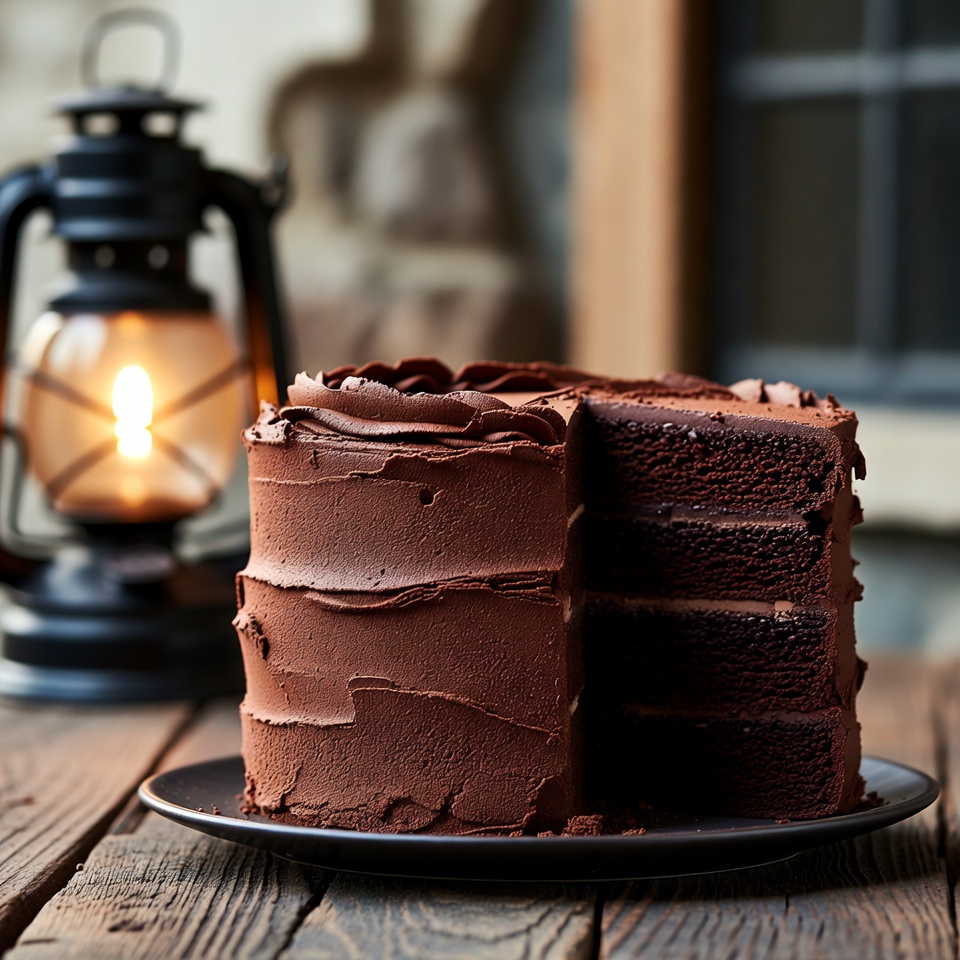
This cake is crowned with a generous layer of chocolate buttercream that’s silky, stable, and intensely chocolatey.
Buttercream Ingredients Recap
- Unsalted Butter – Softened to room temperature so it creams smoothly.
- Confectioners’ Sugar – Sweetens and thickens the frosting.
- Unsweetened Cocoa Powder – Use either natural or Dutch-process here, as leavening isn’t involved in frosting.
- Heavy Cream, Half-and-Half, or Milk – Thins the frosting to a spreadable consistency and adds creaminess.
- Vanilla Extract – Adds depth and enhances the chocolate flavor.
- Salt – A small amount keeps the frosting from tasting overly sweet.
Heavy cream will give the richest, creamiest texture, but milk or half-and-half also works if that’s what you have on hand.
While the chocolate buttercream is truly perfect on this cake, the layers also pair beautifully with:
- Vanilla buttercream
- Strawberry buttercream
Both make excellent alternatives if you’re craving a flavor contrast.
Decorating and Serving: The “Triple Chocolate” Finish
Although the cake has two physical layers, it earns the name triple chocolate layer cake because chocolate appears three times:
- Deep, moist chocolate cake layers
- A thick coat of chocolate buttercream
- Semi-sweet chocolate chips as decoration
To finish:
- Press chocolate chips over the top (and sides, if you like) of the frosted cake.
- You can sprinkle just a handful for a subtle garnish, or fully cover the top and edges for a “more is more” chocolate effect.
Once assembled, slice and serve generous pieces of this ultra-rich, velvety cake—and enjoy every triple-chocolate bite.